
On average, 328 people in the UK and Ireland lose their lives to accidental drowning every year. Half of these deaths happen between May and August, and this year alone has already seen at least 35 lives lost to drowning during a spell of hot weather.
There's a clear link between rising temperatures and rising risk. As soon as the sun comes out, families head to open water, paddling pools and lidos, often without realising how quickly things can turn.
The good news is that most of these tragedies are preventable. If we teach children water safety skills early, those skills stay with them for life. That belief is at the heart of everything we do at Puddle Ducks.
Whether you're at the beach, the local pool or a paddling pool in the garden, a few simple habits make an enormous difference.
Stay close and stay present
Always keep young children within arm's reach in or near water. Never rely on a rubber ring or inflatable jacket to keep them safe, they can tip over in seconds. And put your phone away while you're supervising. Drowning is often silent and quick, not the splashing and shouting we see in films.
Choose your water wisely
Where possible, pick outdoor water spaces with a lifeguard on duty. If you're heading to open water, respect it. Even on a scorching day, water can be surprisingly cold, and there may be hazards you simply can't see beneath the surface. Take time to understand your environment before you get in.
Learn to read the flags
At the beach, swim between the red and yellow flags, that's the lifeguarded safe zone. A red flag on its own means danger, stay out. An orange windsock warns of strong winds, which can carry inflatables out to sea in moments. A black and white quarter flag marks a water sports area, best avoided by swimmers altogether.
If someone is struggling, don't jump in
It's instinct to want to help but never enter the water after a struggling swimmer. Shout for help if there are people nearby to support you. Call 999 immediately. Many beaches now have boards with a code you can use to release an emergency throw rope.
Check the pool, not just the water
At swimming pools, take a moment to check the water quality. Can you see the bottom clearly? Is there evidence of a pool manager checking chemicals throughout the day (the rule is three times daily)? Read the signage for depth levels, exits and safety rules before you get in.
Be careful on poolside
If your toddler can walk, resist the urge to carry them, poolside’s can be slippery. Never carry a child down steps into the water. Instead, sit them on the poolside and help them swivel round and lower themselves in.
Above all, keep watching.
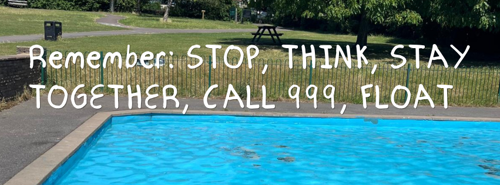
This is the RLSS Water Safety Code, and it's simple enough for the whole family to remember:
- Stop and think: spot the dangers before you get in
- Stay together: never swim alone, and keep children within reach
- Call 999: if someone gets into trouble, get help rather than getting in yourself
- Float: if you fall in unexpectedly, lean back, float, and get your breathing under control before swimming to safety

Water safety runs through everything we do, from our smallest babies right up to our most confident young swimmers.
Even in our baby classes, teachers are quietly educating the grownups as much as the little ones. In our Swim Academy classes, for 4- to 12-year-olds, every session opens with a water safety question, and children need to answer correctly before they can progress to the next level. Learning to float, tread water, turn in the water and swim back to the side are treated as core skills, not extras.
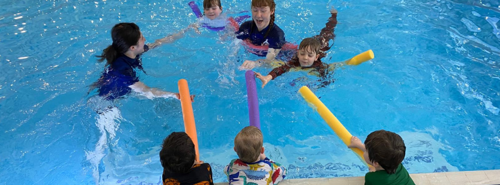
Three times a year we run PJ Week. Children practice safe rescue skills, and the very first lesson is that you never get in to help a struggling swimmer. Everyone wears pyjamas so they can feel firsthand how much harder it is to move through water in clothes. In our Baby and Pre-school (BPS) classes, parents wear PJs too, so they understand exactly what their child is experiencing.
Our vision
At Puddle Ducks Bristol and Bath, our vision is simple: to teach every single child in our territory to swim. We believe we are in the business of saving lives, and water safety sits at the heart of that mission, in every class, every week, for every child.